
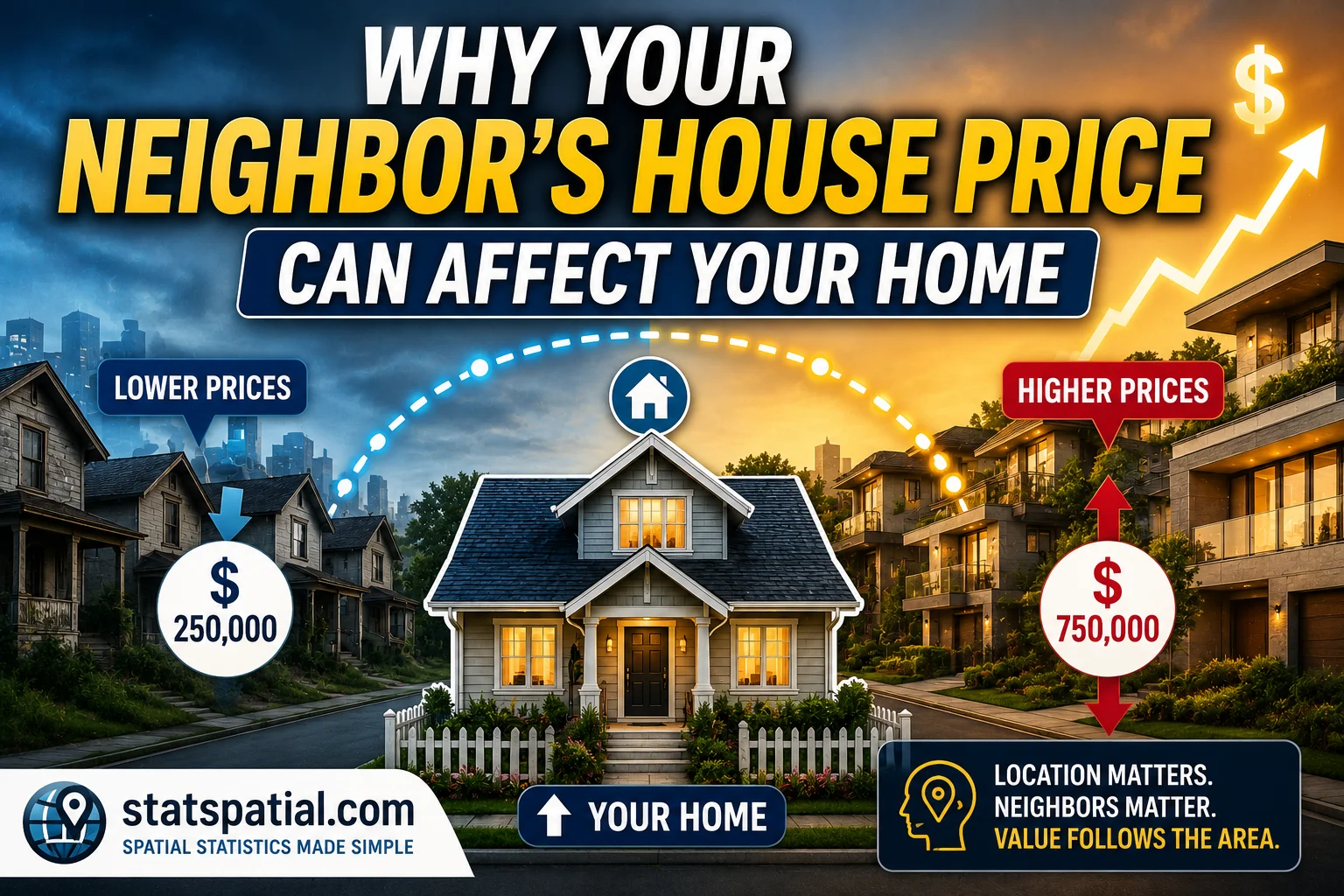
Imagine two houses with almost identical:
- size,
- design,
- number of rooms,
- and land area.
Yet somehow, one house is worth significantly more simply because it is located in a different neighborhood.
Why does this happen? The answer is simple:
A house price never stands alone.
The value of a property is strongly influenced by the surrounding properties and environment. In spatial statistics, this phenomenon is called spatial dependence or spatial autocorrelation.
House Prices Are “Contagious”
Think about the following situations:
- If houses around you are selling at high prices,
your house is likely to be perceived as more valuable too. - If the neighborhood becomes more developed,
nearby property values tend to rise together. - If many homeowners renovate and improve their properties,
the reputation of the entire area improves.
On the other hand:
- abandoned houses,
- poor infrastructure,
- traffic problems,
- or increasing crime rates
can reduce property values across the neighborhood. In other words:
House prices often spread spatially like a ripple effect.
Why This Matters
Many people think house prices depend only on:
- building size,
- number of bedrooms,
- architectural design,
- or land area.
But in reality: location and neighborhood quality are often far more influential. Two identical houses can differ in value by hundreds of thousands of dollars simply because of:
- accessibility,
- school quality,
- nearby facilities,
- neighborhood reputation,
- or surrounding development.
The Neighborhood Effect in Spatial Statistics
In traditional statistics, observations are usually assumed to be independent. However, spatial data rarely behave that way. Why? Because:
“Nearby things tend to be more similar than distant things.”
This idea is known as:
Tobler’s First Law of Geography
Everything is related to everything else, but near things are more related than distant things.
This means that everything is connected, but geographically close objects usually have stronger relationships. That is exactly why neighboring house prices tend to influence one another.
A Simple Example
Imagine a small house located in an ordinary neighborhood. At first, its value is average. Then several changes happen nearby:
- a new highway is built,
- cafés and shopping centers appear,
- schools improve,
- public transportation expands,
- and modern housing projects emerge.
What happens next? Even without major renovations, the value of that house will likely increase. Why? Because the surrounding area itself becomes more valuable.
The Ripple Effect in Real Estate
In property economics, there is a well-known phenomenon called the ripple effect. It describes how rising prices in one area can gradually spread to nearby regions. For example:
when downtown housing becomes too expensive, people begin moving to surrounding suburbs. As demand shifts outward, property prices in neighboring areas also increase. This commonly happens near:
- metropolitan areas,
- transit corridors,
- toll roads,
- and rapidly developing districts.
Why Ordinary Regression Often Fails
Suppose we model house prices using a standard regression:
Price=β0+β1(Land Area)+β2(Bedrooms)
This model assumes the relationship is the same everywhere. But real-world housing markets do not behave uniformly across locations. A factor that matters greatly downtown may have little importance in suburban areas. Because of this, spatial statistical models were developed, such as:
- Spatial Lag Model,
- Spatial Error Model,
- and Geographically Weighted Regression (GWR).
These models explicitly consider the influence of location.
GWR: When Every Location Has Its Own Equation
Traditional regression assumes one global equation for all observations. GWR is different. It allows relationships to vary across space. For example:
- land size may strongly affect prices in dense urban centers,
- while accessibility may matter more in suburban regions.
The basic idea of GWR is:
yi=β0(ui,vi)+∑k=1pβk(ui,vi)xik+εi
This means:
each location has its own local regression parameters. As a result, GWR often provides a more realistic understanding of housing markets.
Why Real Estate Developers Care About Neighborhoods
Property developers understand one important principle:
They are not only selling houses — they are selling the entire environment.
That is why developers invest heavily in:
- parks,
- security,
- roads,
- commercial areas,
- public facilities,
- and transportation access.
Their goal is to create positive spatial effects that increase the value of the entire neighborhood.
What Home Buyers Should Learn From This
When buying a house,
do not focus only on the building itself. You should also evaluate:
- neighborhood quality,
- nearby property trends,
- transportation access,
- future development plans,
- and surrounding property conditions.
Because:
Even a beautiful house can lose value if the surrounding environment deteriorates.
And conversely: a modest house can become highly valuable if the neighborhood rapidly develops.
Conclusion
House prices are not determined solely by the building itself. They are influenced by:
- neighboring properties,
- local environment,
- accessibility,
- urban development,
- and spatial relationships.
Spatial statistics help us understand these hidden geographic connections. And in the end, it turns out that:
Your neighbor’s house really can influence the value of your own home.