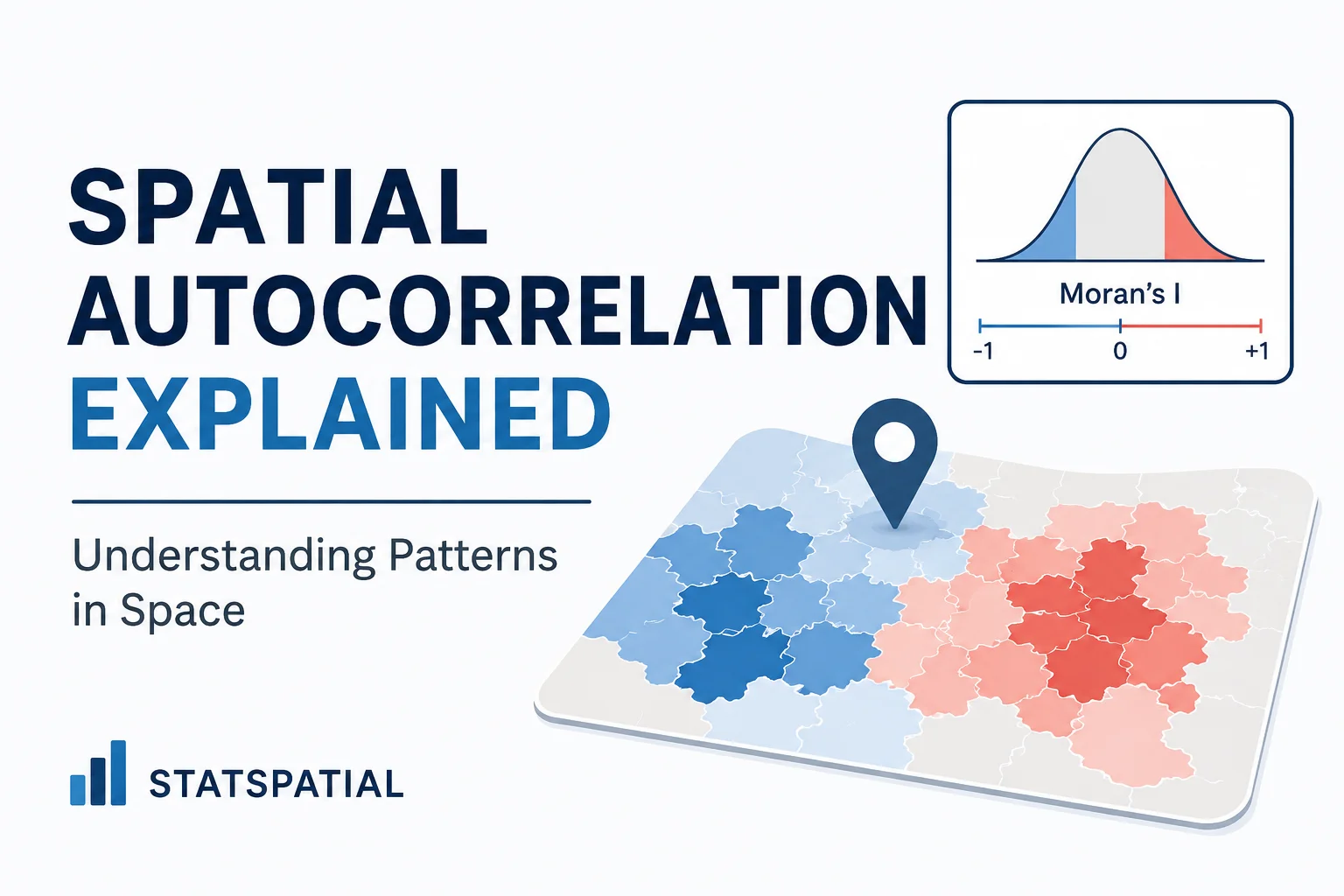
Spatial autocorrelation refers to the degree to which nearby geographic observations are similar or dissimilar to each other.
In simple terms:
Spatial autocorrelation measures whether spatial patterns are clustered, dispersed, or random.
It is one of the most fundamental concepts in:
- GIS,
- spatial statistics,
- spatial econometrics,
- geography,
- spatial data science.
Why Spatial Autocorrelation Matters
Traditional statistical methods assume that observations are independent.
However, spatial data often violates this assumption because nearby locations tend to influence one another.
Examples:
- neighboring districts often have similar income levels,
- nearby houses tend to have similar prices,
- adjacent regions may share similar climate conditions,
- disease outbreaks often cluster geographically.
This phenomenon is known as spatial dependence.
Tobler’s First Law of Geography
Spatial autocorrelation is closely related to:
“Everything is related to everything else, but near things are more related than distant things.”
— Waldo Tobler
This principle explains why spatial autocorrelation exists in many real-world phenomena.
Types of Spatial Autocorrelation
There are three major patterns:
| Type | Meaning |
|---|---|
| Positive Spatial Autocorrelation | Nearby values are similar |
| Negative Spatial Autocorrelation | Nearby values are dissimilar |
| Zero Spatial Autocorrelation | Spatial randomness |
1. Positive Spatial Autocorrelation
High values tend to be near high values, and low values near low values.
Example:
- expensive houses cluster together,
- high-income neighborhoods are adjacent.
Positive Spatial Autocorrelation Example


5
2. Negative Spatial Autocorrelation
High values tend to be near low values.
Example:
- checkerboard-like patterns,
- alternating land-use zones.
Negative Spatial Autocorrelation Example


7
3. No Spatial Autocorrelation
Spatial patterns appear random.
Nearby observations do not show systematic similarity.
Random Spatial Pattern Example


7
Why Spatial Autocorrelation Is Important
Spatial autocorrelation affects:
- statistical inference,
- regression models,
- prediction accuracy,
- hypothesis testing.
Ignoring spatial autocorrelation can lead to:
- biased standard errors,
- misleading significance tests,
- incorrect conclusions.
Global vs Local Spatial Autocorrelation
Spatial autocorrelation can be analyzed at two levels.
| Type | Purpose |
|---|---|
| Global Spatial Autocorrelation | Measures overall spatial pattern |
| Local Spatial Autocorrelation | Detects local clusters and hotspots |
Global Spatial Autocorrelation
Global measures summarize the overall spatial pattern of an entire study area.
The most famous method is:
Moran’s I
Moran’s I Formula
I=∑i∑jwijn∑i(xi−xˉ)2∑i∑jwij(xi−xˉ)(xj−xˉ)
Where:
| Symbol | Meaning |
|---|---|
| n | Number of observations |
| xi | Value at location i |
| wij | Spatial weight between locations |
| xˉ | Mean value |
Interpretation of Moran’s I
| Moran’s I Value | Interpretation |
|---|---|
| I>0 | Positive spatial autocorrelation |
| I<0 | Negative spatial autocorrelation |
| I≈0 | Spatial randomness |
Spatial Weight Matrix
Spatial autocorrelation depends on defining neighborhood relationships.
This is represented using a spatial weight matrix.
Example:
- neighboring districts = 1,
- non-neighbors = 0.
Spatial Weight Matrix Illustration


6
Common Spatial Weight Methods
| Method | Description |
|---|---|
| Contiguity-based | Shared boundaries |
| Distance-based | Based on geographic distance |
| k-Nearest Neighbor | Closest neighbors |
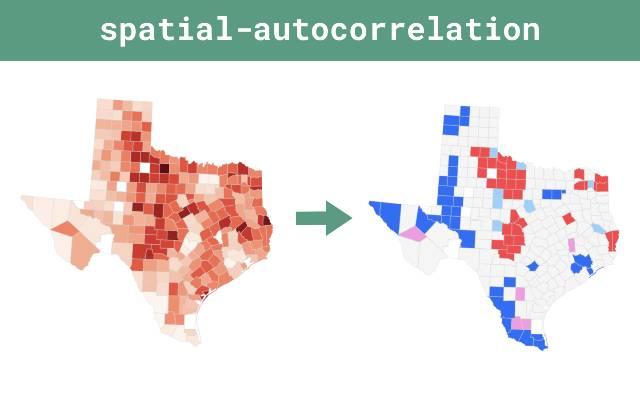
Local Spatial Autocorrelation (LISA)
Local Indicators of Spatial Association (LISA) identify local clusters such as:
- hotspots,
- coldspots,
- spatial outliers.
LISA Cluster Types
| Cluster | Meaning |
|---|---|
| High-High | High values surrounded by high values |
| Low-Low | Low values surrounded by low values |
| High-Low | Spatial outlier |
| Low-High | Spatial outlier |
LISA Cluster Map Example
6
Applications of Spatial Autocorrelation
Spatial autocorrelation is widely used in:
| Field | Example |
|---|---|
| Real Estate | House price clustering |
| Epidemiology | Disease hotspots |
| Urban Planning | Land-use patterns |
| Environmental Science | Pollution clustering |
| Transportation | Traffic congestion analysis |
| Agriculture | Soil variability |
Spatial Autocorrelation in R
R provides powerful tools for spatial autocorrelation analysis.
Common packages:
sfspdeptmap
Install Required Packages
install.packages(c("sf", "spdep"))
Load Packages
library(sf)library(spdep)
Read Spatial Data
data <- st_read("districts.shp")
Create Spatial Neighbors
neighbors <- poly2nb(data)
Convert to Spatial Weight Matrix
weights <- nb2listw(neighbors)
Compute Moran’s I
Suppose the variable is:
- poverty rate,
- house price,
- unemployment rate.
moran.test(data$poverty_rate, weights)
Example Output
Moran I statistic standard deviate = 4.82p-value = 0.00001Moran's I = 0.41
Interpretation:
- Moran’s I = 0.41
- positive spatial autocorrelation exists,
- nearby regions tend to have similar poverty rates.
Visualizing Spatial Autocorrelation
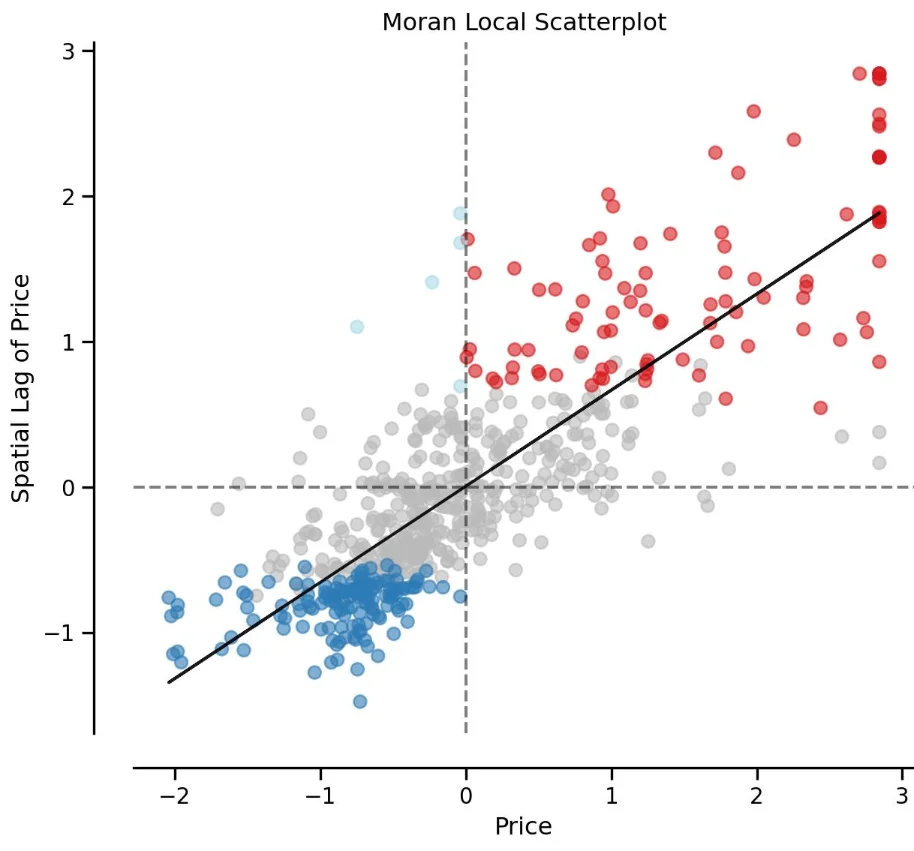
Moran Scatter Plot
moran.plot(data$poverty_rate, weights)
Moran Scatter Plot Example

5
Mapping Local Moran’s I
local_moran <- localmoran(data$poverty_rate, weights)data$Ii <- local_moran[,1]plot(data["Ii"])
Spatial Autocorrelation and Regression
One major implication:
OLS regression assumptions may fail.
If residuals contain spatial autocorrelation:
- coefficients may remain unbiased,
- but inference becomes unreliable.
This motivates spatial regression models such as:
- Spatial Lag Model (SLM),
- Spatial Error Model (SEM),
- Geographically Weighted Regression (GWR).
Common Mistakes
1. Ignoring CRS
Spatial relationships depend on coordinate systems.
2. Using Incorrect Spatial Weights
Different neighbor definitions may produce different results.
3. Assuming Correlation Means Causation
Spatial clustering does not necessarily imply causal relationships.
Spatial Autocorrelation vs Traditional Correlation
| Traditional Correlation | Spatial Autocorrelation |
|---|---|
| Relationship between variables | Relationship across space |
| No location information | Spatial location matters |
| Independent observations assumed | Spatial dependence considered |
Conclusion
Spatial autocorrelation measures how strongly geographic observations relate across space.
It is one of the most important concepts in:
- GIS,
- spatial statistics,
- spatial econometrics,
- spatial data science.
Understanding spatial autocorrelation helps analysts:
- detect clustering,
- identify spatial patterns,
- improve regression models,
- avoid misleading statistical inference.
Methods such as Moran’s I and LISA have become essential tools for modern spatial analysis.