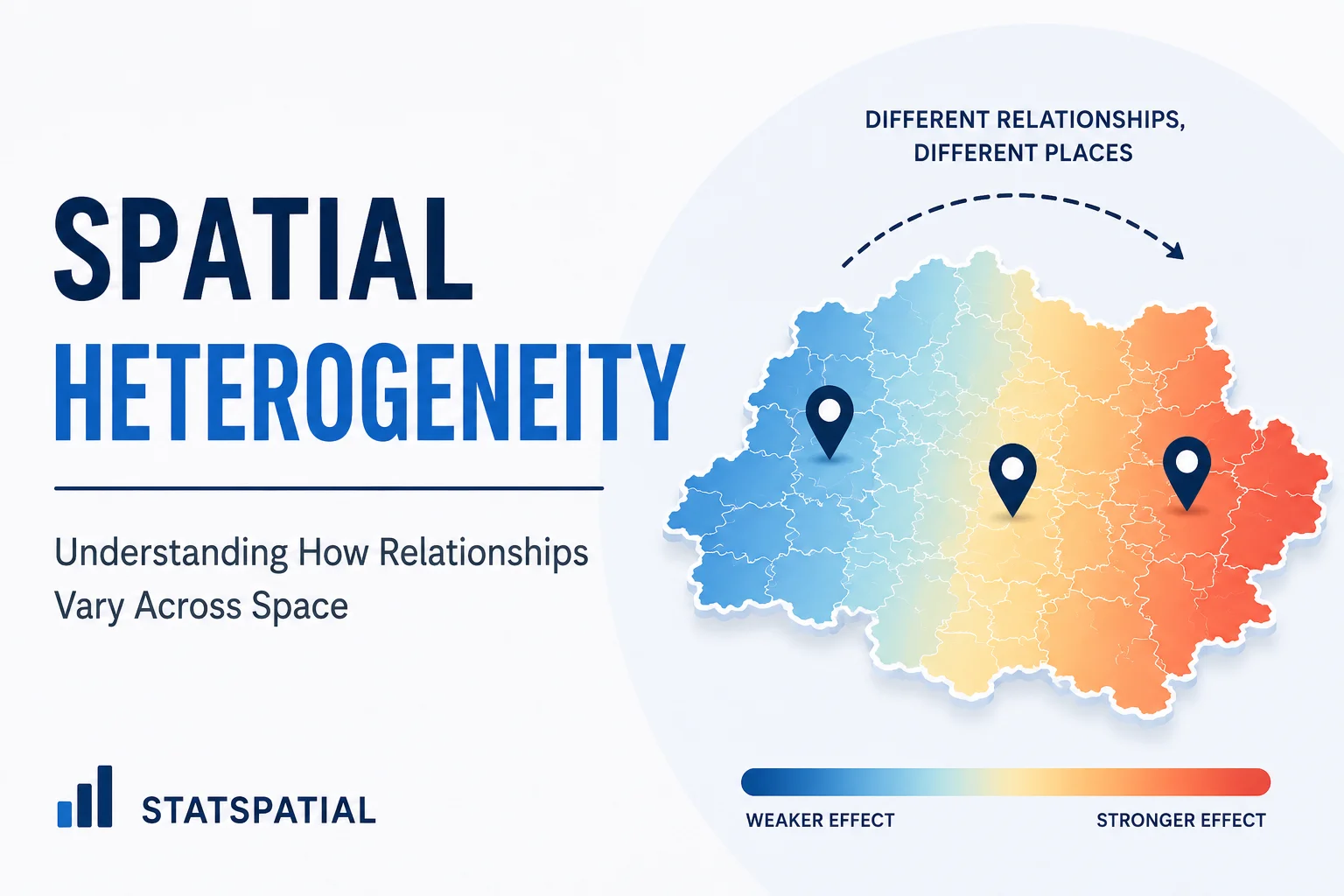
Spatial heterogeneity refers to the condition where relationships, patterns, or processes vary across geographic space. In simple terms:
A relationship observed in one location may not behave the same way in another location.
Spatial heterogeneity is one of the core concepts in:
- GIS,
- spatial statistics,
- spatial econometrics,
- spatial data science,
- geography.
Why Spatial Heterogeneity Matters
Many traditional statistical models assume:
- relationships are constant,
- parameters are globally fixed,
- one model applies equally everywhere.
However, real-world spatial processes are rarely uniform. Examples:
- the effect of distance to the city center on house prices differs between urban and rural areas,
- rainfall impacts agricultural productivity differently across regions,
- education may influence income differently across provinces,
- accessibility may affect land value differently between metropolitan and suburban areas.
These spatially varying relationships indicate spatial heterogeneity.
Spatial Heterogeneity vs Spatial Autocorrelation
Spatial heterogeneity and spatial autocorrelation are related but fundamentally different concepts.
| Concept | Meaning |
|---|---|
| Spatial Autocorrelation | Nearby observations tend to be similar |
| Spatial Heterogeneity | Relationships vary across space |
Spatial autocorrelation focuses on: similarity among neighboring observations. Spatial heterogeneity focuses on: variation in relationships or processes across locations.
Example of Spatial Heterogeneity
Suppose we model house prices using: house size, distance to the CBD.
A traditional regression model may be written as:
Price=β0+β1(Size)+β2(Distance)+ε
This model assumes: β1 and β2 are constant everywhere.
In reality:
- distance to the CBD may strongly affect prices in dense urban areas,
- but have weak influence in rural regions.
This indicates that the relationship varies spatially.
Why Spatial Heterogeneity Occurs
Spatial heterogeneity arises because locations differ in:
- economic conditions,
- demographics,
- accessibility,
- infrastructure,
- environmental conditions,
- policy,
- land use,
- social behavior.
Geographic context changes how variables interact.
Types of Spatial Heterogeneity
Spatial heterogeneity can appear in several forms.
| Type | Description |
|---|---|
| Structural Heterogeneity | Relationships differ spatially |
| Variance Heterogeneity | Variability differs across locations |
| Functional Heterogeneity | Different processes operate in different regions |
| Scale Heterogeneity | Relationships change across spatial scales |
Structural Spatial Heterogeneity
Regression relationships vary geographically. Example:
- income may strongly influence housing prices in cities,
- but weakly influence prices in rural regions.
Variance Heterogeneity
The variability of observations differs spatially. Example:
- property prices may fluctuate heavily in downtown areas,
- but remain relatively stable in suburban zones.
Spatial Nonstationarity
Spatial heterogeneity is closely related to spatial nonstationarity. A spatial process is nonstationary when:
- statistical relationships change across geographic space.
Stationary vs Nonstationary Processes
| Stationary Process | Nonstationary Process |
|---|---|
| Relationships constant | Relationships vary spatially |
| Global structure | Local variation |
| One model sufficient | Local analysis needed |
Visualization of Spatial Heterogeneity
Spatially Varying Relationship

Why Global Models May Be Problematic
Many global statistical models assume: y=Xβ+ε
where: β is constant across all locations.
When spatial heterogeneity exists:
- important local variation may be hidden,
- model accuracy may decline,
- local patterns may be oversimplified.
Detecting Spatial Heterogeneity
Several approaches can help identify spatial heterogeneity.
1. Residual Mapping
Spatially clustered residuals may indicate:
- missing local variation,
- unmodeled spatial processes.
Regional Comparison
Relationships can be compared across:
- cities,
- provinces,
- districts,
- spatial clusters.
Large differences may indicate spatial heterogeneity.
Exploratory Spatial Data Analysis (ESDA)
Spatial Heterogeneity in Real Estate
Spatial heterogeneity is especially important in property valuation.
Examples:
- proximity to public transportation may strongly increase property value in urban centers,
- but have limited effect in low-density suburban regions.
Similarly:
- school quality may strongly affect prices in some districts,
- but weakly affect prices elsewhere.
Spatial Heterogeneity in Environmental Studies
Examples include:
- rainfall effects varying by elevation,
- pollution behavior differing across industrial zones,
- climate impacts changing geographically.
Spatial Heterogeneity in Public Health
Examples:
- disease transmission differs across regions,
- healthcare accessibility varies spatially,
- socioeconomic factors influence health outcomes differently across cities.
Spatial Heterogeneity in R
R provides powerful tools for exploring spatial heterogeneity.
Common packages:
sftmapspdepggplot2
Install Required Packages
install.packages(c("sf", "tmap", "ggplot2"))
Load Packages
library(sf)library(tmap)library(ggplot2)
Read Spatial Data
data <- st_read("housing.shp")
Suppose the dataset contains:
- housing price,
- distance to CBD,
- district boundaries.
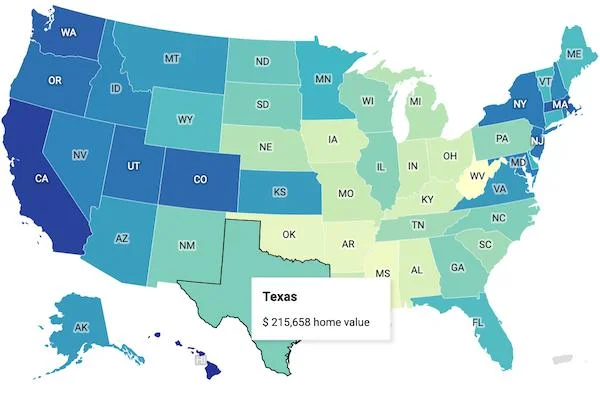
Visualize Spatial Distribution
tm_shape(data) + tm_polygons("price")
Example Spatial Distribution Map

Compare Regional Relationships
Suppose we estimate separate regressions for:
- urban areas,
- suburban areas.
urban_model <- lm(price ~ distance_cbd, data = urban_data)suburban_model <- lm(price ~ distance_cbd, data = suburban_data)summary(urban_model)summary(suburban_model)
Interpretation
Suppose results show:
| Region | Coefficient of Distance |
|---|---|
| Urban | -0.85 |
| Suburban | -0.20 |
Interpretation:
- distance strongly reduces prices in urban areas,
- but has weaker influence in suburban regions.
This indicates spatial heterogeneity.
Mapping Residuals
Residual maps can reveal hidden spatial variation.
model <- lm(price ~ size + distance_cbd, data = data)data$residuals <- residuals(model)tm_shape(data) + tm_polygons("residuals")
Example Residual Map


Conclusion
Spatial heterogeneity refers to geographic variation in relationships, variability, and spatial processes across locations.
It highlights the fact that:
- relationships are often not constant over space,
- geographic context matters,
- local variation is important in spatial analysis.
Understanding spatial heterogeneity is essential in:
- GIS,
- spatial statistics,
- spatial econometrics,
- spatial data science.
Ignoring spatial heterogeneity may lead to:
- oversimplified models,
- misleading conclusions,
- reduced predictive accuracy.