
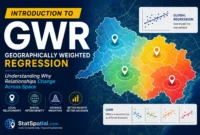
When analyzing data, one common assumption is that the relationship between variables is the same everywhere. For example, we might […]
Category: GIS
GIS
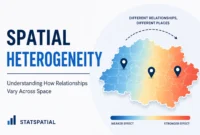
Spatial Heterogeneity Explained
Spatial heterogeneity refers to the condition where relationships, patterns, or processes vary across geographic space. In simple terms: A relationship […]
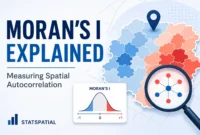
Moran’s I Explained
Moran’s I is one of the most widely used statistics for measuring spatial autocorrelation. It evaluates whether similar values cluster […]
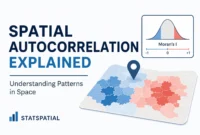
Spatial Autocorrelation Explained
Spatial autocorrelation refers to the degree to which nearby geographic observations are similar or dissimilar to each other. In simple […]
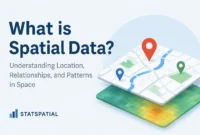
What is Spatial Data?
Spatial data is data that contains information about location, shape, and the relationship between objects in space. Unlike ordinary tabular […]
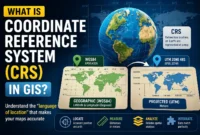
What is Coordinate Reference System (CRS) in GIS?
The Hidden Reason Why Your Maps Sometimes Appear in the Wrong Place Have you ever opened a map in GIS […]
Shapefile
The shapefile is a widely used geospatial vector data format developed and maintained by Esri, a global provider of geographic […]
Well-Known Text (WKT)
Well-Known Text (WKT) is a standard text format for representing spatial geometric objects and coordinate systems in GIS. WKT is […]
Why GIS is important ?
If there is no Google Map, we might have difficulty finding our destination. A lot of research has been done […]
What is GIS?
Geographic Information Systems is a framework used to create spatial data, manage it, visualize it in maps, and analyze and […]