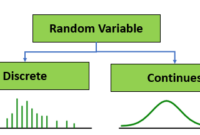

In everyday life, you often having to make decisions when you are unsure with the results. Should you invest money in stock market? Should you get insurance extra accidents on your car?
“Probabilities are the proportion of outcomes that are will occur in long-term observations long.”
Probabilities can also be defined as
“A numerical measure of the probability of occurrence an event”.
Properties of Probabilities:
- The probability of event E, P(E), must be at between 0 and 1: 0 < P(E) < 1
- If an event is impossible to happen, opportunity the event is 0.
- If the event is almost certain to occur, then the probability is 1.
- If S = {e1 , e2 , …, en }, then P(e1 ) + P(e2 ) + … + P(en ) = 1 where S is the sample space.

Sample space And Events
A RANDOM EXPERIMENT has the results that are not available predicted with certainty previously. However, even though not yet the results are known with certainty, but all together possible experimental results what might happen can be known.
Collection of all results from possible randomized trials occurs is called Sample Space and symbolized with S. Set of parts of space an example is called an Event. Algebraic operations (combination, slice, complement, etc.) which applies to set theory as well applies to events.
Sample space illustration (Illustration-1):
The Statistical Methods Quiz consists of 3 multiple choice questions. Each question has 2 answer choices. Suppose the answer is correct denoted C and incorrectly denoted I. How many possible answers do you have from the quiz? Sample Space can be calculated using tree diagram S={CCC, CCI, CIC, CII, ICC, ICI, IIC, III}

Events Illustration (from Illustration-1 above):
Events are denoted with capital letters, for example E. Look at Illustration-1, for example X state the student’s answer all true, then X= {CCC}, and Y represent at least two answers are correct, then Y={CCC, CCI, CIC, ICC}, and Z represent two the answer is correct, then E={CCI,CIC,ICC}.
Deterministic Processes vs Random Processes
First we should know the differences between deterministic process and the random process. In deterministic processes, the results experiments can be predicted with certainty. As an illustration: Pressure = mass x acceleration. If given the mass and acceleration values, the pressure can be calculated with certainty.
On the other side, random processes: the results of the experiment are not known for certain, but the probability distribution of all the possible outcomes described. As an illustration: a balanced coin is thrown 10 times, the number of Head/Tail (H/T) sides that appear is not known for certain, but still the chances of getting the H/T side can be calculated.
Randomized Trial
The results of the experiment are unpredictable with certainty 0 in chance, trial is any process that can be repeated and the results contain uncertainty. As an illustration: random experiment on package delivery.

Why is it called a Randomized Trial? Because it is not known whether the package reached its destination or not, and although the package reaches its destination, it is not known how long it will take necessary to reach the destination.